
By Tessar Napitupulu, founder and CEO of Arfadia, the agency that introduced GEO in Indonesia, and a member of the Forbes Agency Council. Tools tested 21 to 25 September 2026.
There is no single best SEO tool, and our testing shows exactly why. When we ran Ahrefs, Semrush, and Moz on the same domains on the same days, they disagreed on every number they sell, and the two traffic estimates we could check against Google Search Console came in 7.1 and 9.2 times higher than what Google actually recorded. For most teams the best setup is Google Search Console as the source of truth, plus one paid suite picked for the job you do most: Ahrefs for link and competitor research, Semrush for an all-in-one SEO and PPC workflow, and Screaming Frog for technical crawling.
That's the short answer. The rest of this guide shows the receipts.
Most "best SEO tools" articles are feature tours. They list what each platform can do, paste in the pricing, and call it a review. Almost none of them check whether the numbers those platforms produce are actually right. So we did. Six tests, four domains, three SEO suites, two countries, and 30 answers from five AI assistants. Every figure below has a date next to it, and every one of them can be re-run by you.
What We Found, in Six Lines
| Test | What we measured | Result |
|---|---|---|
| 1. Traffic estimates | Tool estimate vs. Search Console clicks, one domain | Ahrefs 7.1x too high, Semrush 9.2x too high |
| 2. Authority scores | DR, Authority Score, and DA on four domains | Up to 35 points apart on a 100-point scale |
| 3. Backlink counts | Backlinks and referring domains on four domains | Each tool ranked its own domain first |
| 4. Keyword volume | Ten keywords, US and Australia | At least 500x disagreement on one Australian keyword |
| 5. Site crawls | Three crawlers on one site | They found 1, 0, and 28 broken pages |
| 6. AI recommendations | Five AI assistants, 30 answers | Semrush was the top pick in 28 of 30 |
None of this means the tools are bad. It means they are models, not measurements, and you should know which of their numbers to trust before you put one in a client report.
The 8 Best SEO Tools in 2026, Ranked by the Job They Do Best
The order below isn't a popularity contest. It's the order we'd actually set up a stack in, starting from the free source of truth and adding paid tools only where they earn their place. Every verdict points back to a test further down the page.
1. Google Search Console: The Only Source of Truth (Free)
Google Search Console is the one tool on this list that reports what Google itself recorded: real clicks, real impressions, the real queries your pages showed up for. Everything else is an estimate. In our testing, it was the yardstick we measured every other tool against, and it's the reason we could catch the traffic estimates in Test 1 running seven to nine times too high.
The limits are real, though. It only covers sites you've verified, so there's zero competitor data. It keeps 16 months of performance history. And it tells you nothing about backlinks from other tools' indexes or keyword difficulty. If you want to slice its exports further, pulling them into a spreadsheet works well; our guide to building a pivot chart in Excel walks through exactly that with a real Search Console export.
Best for: every site owner, before spending a dollar on anything else. Price: free.
2. Ahrefs: Best for Link and Competitor Research
Ahrefs was the strongest research tool in our tests, with a few asterisks. On our small test domain it found the most referring domains of the three suites (6,200, against 4,600 for Semrush and 3,400 for Moz). Its site audit crawled deepest, reaching 5,461 URLs, although the other two crawlers ran on free plans with crawl caps. And in the AI answers we collected, it was mentioned in all 30, even when it wasn't the top pick.
Now the asterisks. Its traffic estimate for our domain was 7.1 times higher than Search Console. On the three large domains we tested, it found the fewest referring domains, not the most. And during testing our workspace hit its monthly crawl credit ceiling, which left 47,694 discovered links uncrawled until the reset date. More on that in Test 5.
Price, checked 25 September 2026: Lite $129/mo (5 projects, 750 tracked keywords, 100,000 crawl credits), Standard $249/mo (20 projects), Advanced $449/mo (50 projects), and Enterprise at $1,499/mo on an annual commitment. There's also a $29 Starter plan. Ahrefs states on its pricing page that it doesn't run discounts, though annual billing saves up to 17%.
3. Semrush: Best All-in-One for SEO Plus PPC
If you asked an AI assistant, Semrush would already be your answer. It was the top recommendation in 28 of the 30 AI responses we collected (Test 6). And for teams that run paid search next to organic, the combined toolkit is a genuine reason to pick it.
But its numbers ran hottest in our tests. The traffic estimate for our domain was 9.2 times higher than Search Console, the biggest overshoot we measured. It was also the harshest judge of authority: Semrush gave the lowest score to three of the four domains we checked, including a 65 for moz.com, where Ahrefs and Moz both said 91.
Price, checked 25 September 2026: the SEO plan is $139/mo (5 websites, 500 tracked keywords), Starter is $199/mo (adds 50 tracked AI prompts per day and MCP access), Pro+ is $299/mo (15 websites), and Advanced is $549/mo (40 websites, API access). There's a free plan capped at 10 reports a day. We tested on that free plan, which is worth knowing: its site audit stops at 100 pages and ran with JavaScript rendering disabled.
4. Screaming Frog SEO Spider: Best Technical Crawler
Screaming Frog is a desktop crawler, which sounds old-fashioned until you realize what that means. It crawls your live site from your own machine, right now, instead of showing you a cached crawl from a cloud index. We ran version 24.3. It crawled 438 URLs on our domain: 432 returned a 200 status, 5 were redirects, and exactly 1 was a broken page.
The free version stops at 500 URLs per crawl, which covers most small business sites entirely. Past that, the paid licence removes the cap. The ceiling then becomes the memory and storage on your own computer, which is the trade-off for running locally.
Price: free up to 500 URLs. The paid licence is £199, $279, or €245 per user per year, according to Screaming Frog's own FAQ. No monthly option.
5. Moz Pro: Cheapest Paid Entry for a Single Site
Moz Pro's Starter plan at $49/mo is the lowest-priced way into a paid suite if you manage one site. It's also the tool whose Domain Authority gave our small domain the highest score of the three (71, against 66 from Ahrefs and 36 from Semrush). On the three big domains, Moz found the most linking domains every time.
One gap showed up clearly on the free account we used: Moz's domain overview offered no organic traffic estimate at all, so it couldn't take part in Test 1. Honestly? That's arguably better than an estimate that's nine times too high.
Price: Starter $49/mo (1 site), Standard $99/mo (3 sites), Medium $179/mo (10 sites), Large $299/mo (25 sites). Annual billing takes about 20% off.
6. Google Keyword Planner: Free Volume Check, With a Catch
Keyword Planner lives inside Google Ads and uses Google's own search data, which makes it the obvious sanity check for any volume figure a third-party tool gives you. It's free with a Google Ads account.
Here's the catch. Accounts without active ad spend only see ranges, like "1K to 10K," not exact numbers. And it groups close variants together. In Australia, it gave three different keyword variants the same volume band and the same bid range down to the last digit, which is how you spot a grouped bucket. The column most people ignore, Three month change, turned out to be the most useful one on the screen. Test 4 explains why.
Best for: checking whether a volume figure is even in the right order of magnitude. Price: free.
7. Google Trends: Best Free Check on the Shape of Demand
Trends doesn't give you volume. It gives you shape, and shape is what tells you whether a number is real demand or a one-off spike. In our testing, the US curve for "best seo tool" was steady through the year, while the Australian curve sat near the floor with a few short spikes. That single chart was the first clue that the huge Australian volume figure in Ahrefs didn't describe a real, stable audience.
One limitation our tester confirmed: the standard Trends interface applies one region to the whole chart, so you can't plot the same keyword in two countries on one graph. You'll need two screenshots.
Price: free, no login required.
8. Ahrefs Brand Radar and Semrush AI Visibility: For Tracking AI Search
If your buyers ask ChatGPT or Gemini before they ever open Google, rank tracking alone won't show you the whole picture. Both of the big suites now sell AI visibility tracking. Ahrefs Brand Radar AI starts at $199/mo as a standalone tool, and Ahrefs says its database covers more than 475 million organic prompts; every Ahrefs plan also includes a few tracked AI prompts (5 on Lite, 10 on Standard, 20 on Advanced). Semrush includes AI visibility features across its plans, with 50, 100, or 200 tracked prompts per day on Starter, Pro+, and Advanced.
A word of caution. Neither pricing page explains how a mention or a citation is actually detected. So treat these counts as a trend line inside one tool, and don't compare an Ahrefs number to a Semrush number. If AI visibility is becoming a real channel for you, that's the territory of generative engine optimization, and our AI Citation Rate Report 2026 covers how citation rates were measured across platforms.
How We Tested (and What We Couldn't Control)
We wanted numbers anyone could check, so here's everything.
The domains. We used four: arfadia.com, ahrefs.com, semrush.com, and moz.com. Arfadia is the agency that publishes this blog, and we used our own domain for one reason only: it's the one site where we can open Google Search Console and see the real numbers. You can't check a traffic estimate against the truth on a site you don't own. The three vendor domains let each tool measure its competitors, and itself, on equal terms.
The dates. Search Console data covers 1 June to 31 August 2026, a total of 92 days. Tool readings were taken between 21 and 25 September 2026. The AI assistant answers were all collected on 23 September 2026. Where a single test spans more than one day, we say so in that section.
The plans. We pay for Ahrefs. Semrush and Moz were tested on their free accounts, which limits some features, and we flag those limits wherever they touch a result. Screaming Frog was the free version, 24.3. Keyword Planner ran on a Google Ads account with no active ad spend, which is why it shows ranges.
Conflict of interest. Arfadia is an SEO and GEO agency, so we use tools like these every day and we have opinions. None of the vendors paid for, reviewed, or approved this article. Before publishing, we sent each of the four vendors named in the tests the findings about their product and offered a right of reply.
What we couldn't control. Every one of these indexes updates constantly, so your numbers will differ from ours on a different day. That's fine. The point isn't the exact figure. It's the size of the gaps between tools measuring the same thing at the same time.
Test 1: How Far Off Are SEO Tool Traffic Estimates?
This is the test that almost nobody runs, because it requires access to a site's Search Console. We have that for our own domain, so we ran it.
Over the 92 days from 1 June to 31 August 2026, Search Console recorded 5,874 organic clicks for arfadia.com. That averages 1,943 clicks a month (5,874 divided by 92, multiplied by 30.44). Between 21 and 24 September, Ahrefs estimated the same domain's monthly organic traffic at 13,800. Semrush estimated 17,900.
So Ahrefs was 7.1 times too high. Semrush was 9.2 times too high.
You might object that the tools estimate a current month while we averaged three. Fair point. So we checked against our single best month, August, with 2,351 clicks. Against that, Ahrefs was still 5.9 times too high and Semrush 7.6 times too high. The gap doesn't close.
Created by Arfadia • arfadia.com/blog
Here's why the direction of that gap matters so much. Third-party tools only count traffic from keywords that exist in their own databases, in the countries they track. Search Console counts everything. Logically, a tool's estimate should come in under the real number, because it can't see every query. Instead, both came in far over it.
That points to the model, not the coverage. Traffic estimates are typically built from estimated rankings, estimated click-through rates, and estimated search volumes multiplied together. If one of those inputs is inflated (and Test 4 shows how badly volume can be), the output inherits it. We can't see inside either model, so treat that as a likely explanation rather than a proven one.
The practical rule is simple. Never report a third-party traffic estimate to a client or a manager as "traffic." For your own sites, Search Console is the number. For competitors, estimates are only useful for comparing one domain against another inside the same tool, never as absolute figures.
Test 2: Authority Scores Don't Agree, Especially on Smaller Sites
Domain Rating (Ahrefs), Authority Score (Semrush), and Domain Authority (Moz) all sit on a 0 to 100 scale and all claim to capture roughly the same idea. So we asked all three about the same four domains on 24 September 2026.
| Domain | Ahrefs DR | Semrush AS | Moz DA | Spread |
|---|---|---|---|---|
| arfadia.com | 66 | 36 | 71 | 35 |
| moz.com | 91 | 65 | 91 | 26 |
| ahrefs.com | 91 | 72 | 83 | 19 |
| semrush.com | 92 | 88 | 86 | 6 |
Two patterns jump out. First, Semrush is the strictest scorer: it gave the lowest number to three of the four domains. Second, and more useful, the disagreement gets wider as the site gets smaller. The three tools nearly agree on semrush.com, a 6-point spread. On our own, much smaller domain, they're 35 points apart.
That isn't a quirk of our sample. A 2023 study by Reyes-Lillo, Morales-Vargas, and Rovira, published in Profesional de la información, compared these same three metrics across 3,151 domains. Across the whole sample the metrics correlated strongly, above 0.9, and the authors concluded the three platforms are broadly reliable. But among low-authority domains the correlations fell to between roughly 0.58 and 0.69, and around 9 to 12% of domains had no score at all in at least one of the tools. We saw the same shape on live domains, three years later: close agreement at the top, wide gaps lower down.
Worth saying plainly: none of these three is a Google metric. They're each vendor's own model of link strength. If a client asks why their "authority" is 36 in one report and 71 in another, both numbers are telling the truth about a different model. Pick one, and track it over time.
Test 3: Every Tool Ranks Its Own Domain First on Backlinks
This one surprised us. On 24 September 2026 we pulled total backlinks and referring domains for the same four domains from all three tools.
| Backlinks | Ahrefs | Semrush | Moz |
|---|---|---|---|
| ahrefs.com | 26.7M | 8.2M | 4.8M |
| semrush.com | 21.5M | 36.3M | 44.6M |
| moz.com | 18.8M | 15.2M | 65.6M |
| arfadia.com | 71.7K | 30.6K | 66.2K |
| Referring domains | Ahrefs | Semrush | Moz |
|---|---|---|---|
| ahrefs.com | 116K | 131.9K | 134.7K |
| semrush.com | 139K | 185.2K | 193.6K |
| moz.com | 106K | 154.2K | 193K |
| arfadia.com | 6.2K | 4.6K | 3.4K |
Read the table down each tool's column and rank the three vendor domains by backlinks. Ahrefs puts ahrefs.com first. Semrush puts semrush.com first. Moz puts moz.com first. Three out of three.
2. semrush.com 21.5M
3. moz.com 18.8M
2. moz.com 15.2M
3. ahrefs.com 8.2M
2. semrush.com 44.6M
3. ahrefs.com 4.8M
Created by Arfadia • arfadia.com/blog
Before anyone reads this as cheating, let's be careful. We can't see inside any of these crawlers, and there's a boring, likely explanation: each tool's crawler probably discovers more of the links around its own heavily linked properties, like its own blog, help center, and community. That's a coverage effect. We can observe it. We can't prove intent, and we're not claiming any.
The referring domain numbers tell a messier story, and it's worth reading closely. On our small domain, Ahrefs found the most referring domains (6,200). On all three large domains, Ahrefs found the fewest, and Moz found the most. So "which tool has the biggest link index" depends entirely on which site you point it at and which column you read.
Make sense? The takeaway isn't that one tool is right. It's that backlink totals from different tools can't be compared to each other at all. Pick one tool for link work and measure change over time inside it.
Test 4: Keyword Volumes Can Disagree by 500x
Volume is the number almost every SEO plan starts from, so we checked ten "best SEO tool" keywords in Ahrefs and in Google Keyword Planner on 24 September 2026. Keyword Planner data covers September 2025 to August 2026. Here's the US.
| Keyword (US) | Ahrefs | Keyword Planner | YoY (Planner) |
|---|---|---|---|
| best seo tool | 7,700 | 1K to 10K | 0% |
| best seo tools | 5,700 | 1K to 10K | 0% |
| best tool for seo | 2,600 | Not captured | Not captured |
| best seo ranking tool | 2,400 | 100 to 1K | minus 90% |
| best seo software tool | 1,000 | 100 to 1K | minus 90% |
| what is the best seo tool | 900 | 100 to 1K | 0% |
| best seo audit tool | 900 | 100 to 1K | minus 90% |
| best ai seo tool | 800 | 1K to 10K | plus 900% |
| best seo tool for agencies | 500 | 100 to 1K | 0% |
| best free seo tool | 450 | 100 to 1K | minus 90% |
In the US the two sources mostly agree on scale, but not everywhere. Ahrefs puts "best seo ranking tool" at 2,400 while Keyword Planner says 100 to 1,000. And the reverse happens with "best ai seo tool": Ahrefs says 800, Keyword Planner says 1,000 to 10,000 with a year-on-year change of plus 900%. That's the one keyword in the set where interest is clearly climbing. (Round figures like minus 90% and plus 900% are what you'd expect when a keyword moves from one of Keyword Planner's volume bands to the next, so read them as direction, not precision.)
Here's a detail most people never notice. Ahrefs' own figures for "best seo tool" moved while we were testing. On 12 September it showed 6,500 US searches and a Keyword Difficulty of 55. On 21 September, KD read 49. By 24 September, volume was 7,700 and KD was 45. Same tool, same keyword, twelve days. That's not a flaw so much as a reminder: these are live models that get re-estimated, so a KD score in a strategy deck is a snapshot, not a fact.
Australia is where things fell apart completely, with a disagreement of at least 500 times on a single keyword. That story gets its own section below, because if you market in Australia it changes how you should read every volume figure you see.
Test 5: Three Crawlers, One Site, Three Different Answers
We pointed three crawlers at arfadia.com. Because Ahrefs ran out of crawl credits mid-test (more on that in a second), the runs span three days: Ahrefs on 23 September, Screaming Frog and Semrush on 25 September 2026.
| Measure | Screaming Frog | Semrush | Ahrefs |
|---|---|---|---|
| Plan | Free, v24.3 | Free | Paid |
| Crawl date | 25 Sep 2026 | 25 Sep 2026 | 23 Sep 2026 |
| URLs crawled | 438 | 100 (plan cap) | 5,461 |
| Health score | None given | 84% | 81 |
| Errors | 1 broken page, 5 redirects | 63 | 1,094 |
| Warnings | Not categorized | 192 | 7,304 |
| Broken (404) pages | 1 | 0 | 28 |
One site, three answers to "how many broken pages do I have?": 1, 0, and 28. None of them is wrong. They crawled different amounts of the site. Semrush's free plan stops at 100 pages and ran without JavaScript rendering. Screaming Frog's free version caps at 500 URLs. Ahrefs went furthest, 5,461 URLs, so it found more of everything.
The health scores are the trap. Semrush said 84%. Ahrefs said 81. They look comparable. They aren't. Semrush scored 100 pages; Ahrefs scored 5,461 URLs, and Ahrefs defines its score as the share of internal URLs with no errors. Semrush's dashboard even shows a second, separate number, an "AI Search Health" score of 89% (labeled beta), right next to the first. That's three different scores for one site, from two tools.
So here's the deal. Judge a site audit by the list of specific issues it finds, never by the headline score. And never compare one tool's health score with another's.
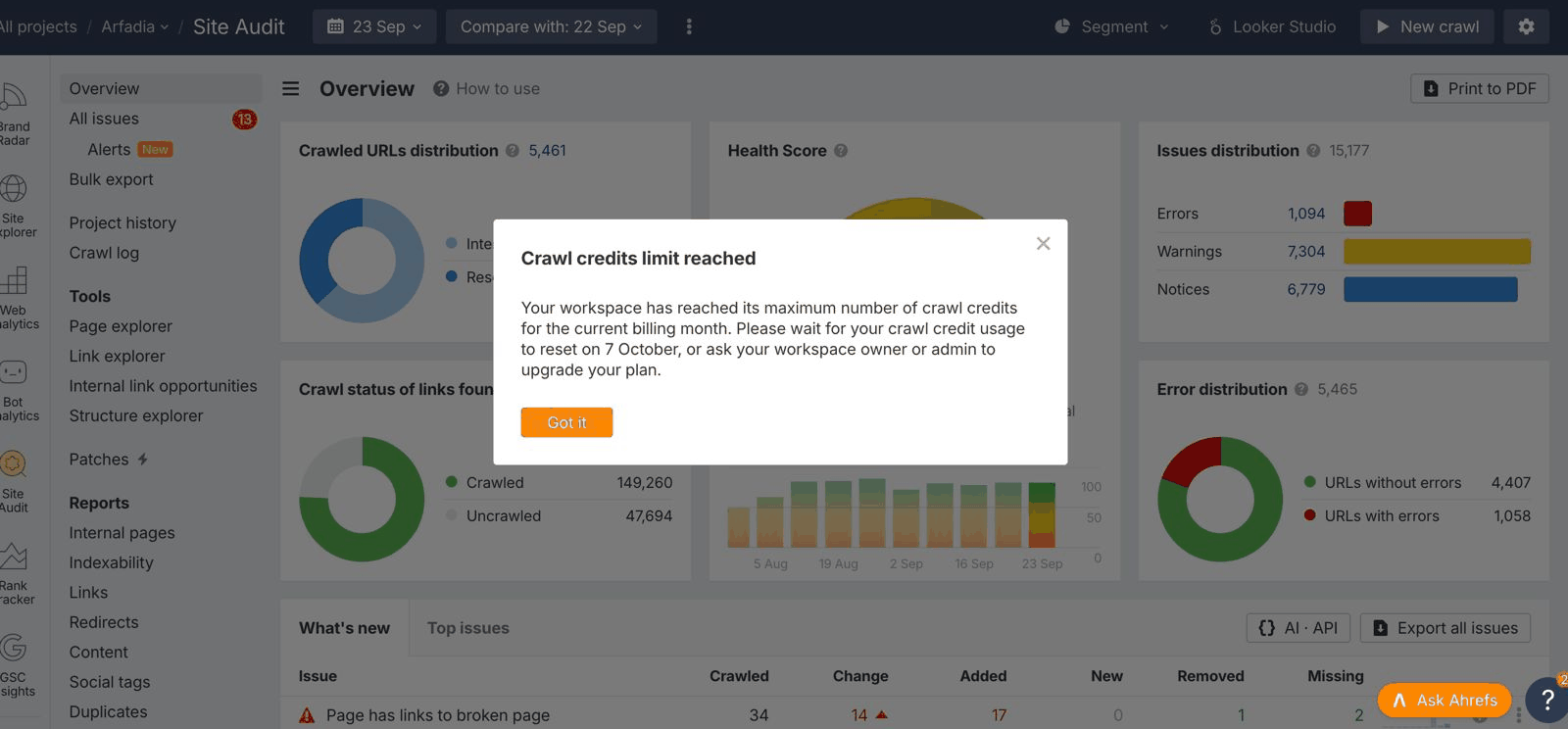
The credit ceiling nobody mentions. Midway through testing, Ahrefs stopped us with a "Crawl credits limit reached" message: our workspace had used its monthly crawl credits and wouldn't reset until 7 October. At that point Ahrefs had discovered 196,954 links on the site, crawled 149,260 of them, and left 47,694 uncrawled. If you didn't know to look, you'd take that audit as complete. Every plan has a crawl credit allowance (100,000 on Lite, 500,000 on Standard, 1.5 million on Advanced), and it's shared across every project in the workspace.
Test 6: What AI Assistants Recommend When You Ask for the Best SEO Tool
More buyers now ask an assistant before they search. So on 23 September 2026 we asked five of them (ChatGPT, Gemini, Claude, Perplexity, and Copilot) three questions: "what is the best SEO tool," "best SEO tool for a small agency," and "best SEO tool in Australia." We ran every question twice, once normally and once through an Australian VPN, using the default consumer version each assistant offered our tester that day. That's 30 answers.
| Assistant | Top pick (6 answers) | Sources shown |
|---|---|---|
| ChatGPT | Semrush, 6 of 6 | 5 of 6 |
| Gemini | Semrush 4 of 6; SE Ranking for small agencies (2 of 6) | 3 of 6 |
| Claude | Semrush 6 of 6, Ahrefs co-pick in 4 | 0 of 6 |
| Perplexity | Semrush 6 of 6, Ahrefs co-pick in 4 | 6 of 6 |
| Copilot | Semrush, 6 of 6 | 0 of 6 |
The pattern is strong. Semrush was the top recommendation in 28 of 30 answers. The only exceptions were Gemini's two answers to the small-agency question, where it picked SE Ranking instead. Ahrefs was named in all 30, usually as the main alternative. And sources were visible in only 14 of the 30 answers; Claude and Copilot didn't show any in any of their responses.
The VPN changed nothing about the picks. Not one of the 15 question-and-assistant pairs got a different top recommendation from Australia. What it did change was the sources. With the Australian VPN on, Gemini's answer to "best SEO tool in Australia" cited a roundup from My Business Marketing Coach, a Melbourne agency, three times on its first screen, and quoted Semrush's starting price as about $139.95 a month, a figure that doesn't match the $139 Semrush's own pricing page listed for its SEO plan two days later. Small, but a good reminder that assistants repeat what other pages say, prices included.
The sources that did appear across all 30 answers included New Standard, SearchEngineInfo, TechnologyAdvice, Toolradar, Worldmetrics, First Page Australia, Capterra, and Rankmax. In the screenshots we captured, none of the pages in Google's US organic top five for "best seo tool" showed up among them.
What does this mean for you as a buyer? An AI assistant's pick reflects what's been written about a tool across the web, not a test of the tool itself. Semrush is a perfectly reasonable choice. Just know that "the AI recommended it" and "it measured our site accurately" are two very different claims, and in our Test 1, the tool the assistants liked most had the largest traffic overestimate.
What the Best SEO Tools Actually Cost Per Project (USD and AUD)
Headline prices hide the number that matters: what you pay for each site you actually manage. So we divided each plan's monthly price by the number of projects or sites it allows. Prices are monthly billing, taken from each vendor's pricing page on 25 September 2026. AUD is converted at the mid-market rate of about 1.425 on the same date, before any local taxes.
| Plan (projects) | USD / month | AUD / month | Per project |
|---|---|---|---|
| Ahrefs Lite (5) | $129 | A$184 | $25.80 / A$36.77 |
| Ahrefs Standard (20) | $249 | A$355 | $12.45 / A$17.74 |
| Ahrefs Advanced (50) | $449 | A$640 | $8.98 / A$12.80 |
| Semrush SEO (5) | $139 | A$198 | $27.80 / A$39.62 |
| Semrush Starter (5) | $199 | A$284 | $39.80 / A$56.71 |
| Semrush Pro+ (15) | $299 | A$426 | $19.93 / A$28.41 |
| Semrush Advanced (40) | $549 | A$782 | $13.72 / A$19.56 |
| Moz Pro Starter (1) | $49 | A$70 | $49.00 / A$69.83 |
| Moz Pro Standard (3) | $99 | A$141 | $33.00 / A$47.02 |
| Moz Pro Medium (10) | $179 | A$255 | $17.90 / A$25.51 |
| Moz Pro Large (25) | $299 | A$426 | $11.96 / A$17.04 |
| Screaming Frog (unlimited sites, 1 user) | $23.25 ($279/yr) | A$33 (A$398/yr) | Not applicable |
Three things to know before you use this table. First, the vendors don't count "projects" the same way. Ahrefs' limits apply to sites you haven't verified you own; your own verified sites are unlimited on every plan. Semrush counts "websites to monitor," and Moz counts "tracked sites." Second, annual billing lowers every paid row: up to 17% off at Ahrefs and Semrush, about 20% at Moz. Third, extra users cost more everywhere. Ahrefs charges $40, $60, or $80 per extra user per month depending on plan, and Semrush's extra users start at $45 a month.
With that said, the pattern is clear. At five sites, Ahrefs Lite ($25.80 per site) and Semrush's SEO plan ($27.80) are close. At the top end, Ahrefs Advanced is the cheapest per project of anything we priced, at $8.98. And if you only run one site, Moz Pro Starter is the cheapest paid door in, even though it's the most expensive per project on paper.
Whichever you pick, the subscription only makes sense if the traffic it helps you win is worth more than it costs. If you want to test that before you buy, our free SEO ROI calculator runs the numbers with no sign-up.
Which SEO Tool Stack Should You Pick?
Based on everything above, here's how we'd set it up for three kinds of teams.
One site, tight budget. Google Search Console, the free version of Screaming Frog, Keyword Planner, and Google Trends. Total cost: $0. Add Moz Pro Starter ($49) or Ahrefs Starter ($29) only when you actually need to look at competitors.
A small team running up to five sites. Search Console on every site, plus either Ahrefs Lite or the Semrush SEO plan at roughly $26 to $28 per site. Pick Ahrefs if link and competitor research is most of the job. Pick Semrush if you also run paid search. Buy the Screaming Frog licence once any site passes 500 URLs.
An agency. Search Console access for every client, one research suite at the Standard or Advanced level (Ahrefs) or Pro+ or Advanced (Semrush), and an AI visibility tracker if clients are asking about ChatGPT and Gemini. The rule that matters most: pick one suite and stay in it. Every test above says cross-tool comparisons produce noise, not insight.
And if you'd rather hand the whole stack to a team that runs these tools daily, that's what our SEO service covers.
Best SEO Tools for Australian Marketers
If you market in Australia, three things in our data should change how you use every tool above.
The Australian Search Results Page Is Different
We compared the Ahrefs SERP exports for "best seo tool" in the US and Australia, both pulled in early September 2026. The AI Overview in Australia cited three sources (two Reddit threads and Zapier), while the US version cited two (one Reddit thread and Zapier). Australia also showed a "Discussions" block at position five, with two Reddit threads and a Quora page, which the US results didn't have at all.
The People Also Ask boxes overlapped by half. Both countries asked "What are the top 5 SEO tools?" and "Can ChatGPT do SEO?" Australia added "How to get 100% SEO?" and "What is the 80/20 rule in SEO?" We answer all of them in the FAQ below.
And the Australian top 30 is far softer. It includes a lot of local agency pages on domains with an Ahrefs DR in the 20s and 30s, and at least one as low as 3, while the US top ten is dominated by Reddit, Zapier, Semrush, and G2, each rated 91 or higher.
The Australian Volume Figure That Isn't Real
This is the big one. On 24 September 2026, Ahrefs reported 193,000 monthly searches in Australia for "best seo tool." For comparison, it reported 7,700 in the US. A country with a fraction of the US population supposedly searching the term 25 times more often? That fails the smell test immediately.
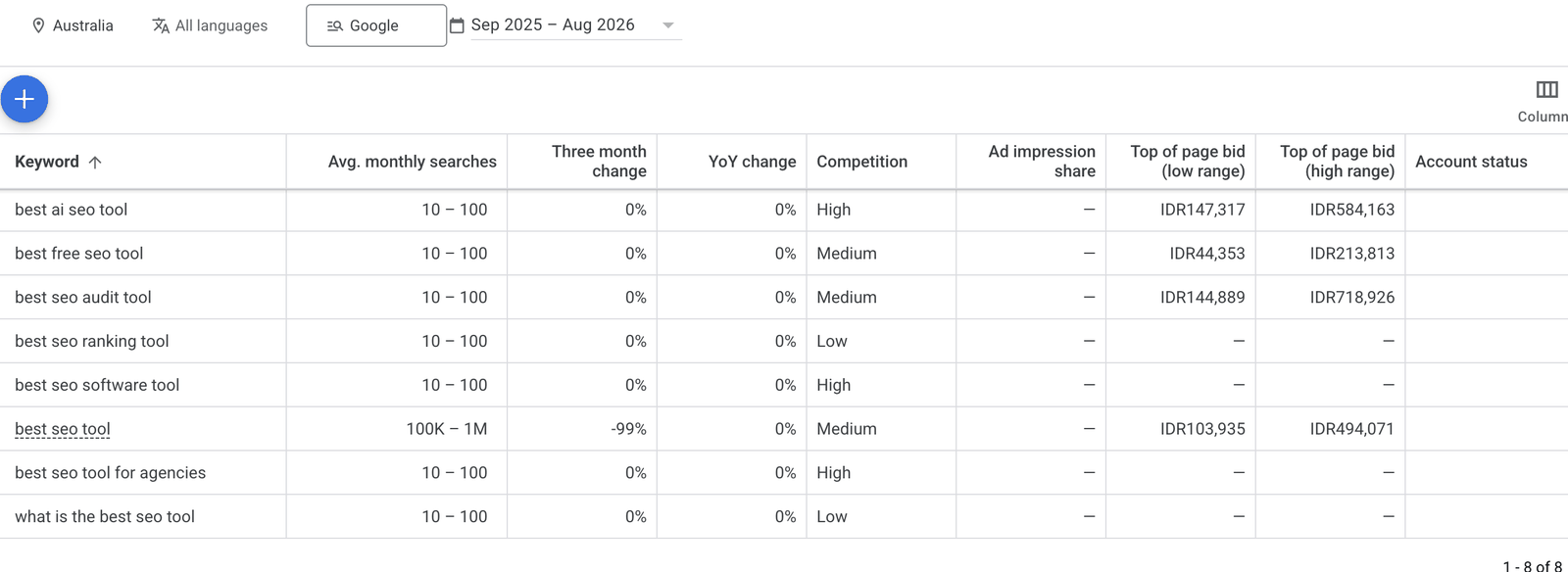
So we opened Google Keyword Planner, and at first glance it seemed to agree: 100,000 to 1 million. But look at the whole row, and at the rows around it.
Created by Arfadia • arfadia.com/blog
Keyword Planner gave "best seo tool," "best seo tools," and "best tool for seo" the exact same band and the exact same bid range. That's one bucket reported three times. And the column beside it, three-month change, read minus 99% for all three. The other seven keywords in our set showed 0%.
Meanwhile Ahrefs split that same bucket very differently: 193,000 for the singular, 200 for the plural, and 100 for "best tool for seo." For "best seo tools" in Australia, Ahrefs says 200 and Keyword Planner says at least 100,000. That's the 500x gap from Test 4.
Put together, the most likely story is simple. Something produced a short, large burst of Australian searches for this term earlier in the 12-month window. It's already gone. The 12-month averages in both tools still carry it. Google Trends shows exactly that shape, and our own Search Console data backs it up: over 92 days, Australian impressions on our site were only 5.5% of US impressions.
The lesson for Australian marketers goes well beyond this one keyword. Before you trust any unusually large Australian volume, open Keyword Planner and read the three-month change column. If it's sharply negative while everything around it is flat, you're looking at a ghost.
What Changes, and What Doesn't, for Australian Buyers
The AI assistants didn't change their minds for Australia. Every top pick was the same with and without the Australian VPN. What changes is cost: in AUD, the entry paid suites land around A$184 to A$198 a month, and Moz Pro Starter is the cheapest paid option at about A$70. The per-project table above has every figure. If you'd like a team on the ground to set this up for an Australian business, see our Australia SEO services.
Want the Playbook for Getting Cited by AI Search?
Test 6 showed how few pages end up in AI answers, and how much the ones that do shape what buyers hear. Cited or Silent: The Definitive GEO, AEO & AI Visibility Playbook by Tessar Napitupulu walks through how brands get named and cited by ChatGPT, Gemini, Perplexity, and Google AI Overviews. The ebook edition is free.
Get the free ebook → It's also available on Apple Books and Google Play.
Frequently Asked Questions
What is the best SEO tool?
There is no single best SEO tool. In our September 2026 tests, the most reliable setup was Google Search Console as the source of truth, plus one paid suite chosen for your main job: Ahrefs for link and competitor research, Semrush for combined SEO and PPC work, and Screaming Frog for technical crawling.
What are the top 5 SEO tools?
Based on our testing, the top five are Google Search Console, Ahrefs, Semrush, Screaming Frog SEO Spider, and Moz Pro. Search Console and the free version of Screaming Frog cost nothing, while the paid suites start at $49 a month for Moz Pro, $29 for Ahrefs Starter or $129 for Ahrefs Lite, and $139 for the Semrush SEO plan.
Are free SEO tools worth it?
Yes, and one of them is essential. Google Search Console is the only tool that shows what Google actually recorded for your site, and in our test paid tools overestimated traffic by 7 to 9 times against it. Free tools lack competitor data, so add a paid suite only when you need to research other sites.
Can ChatGPT do SEO?
ChatGPT can help with SEO tasks like drafting content, outlining pages, and explaining data you paste into it, but it doesn't see your Search Console data or crawl your site on its own. When we asked it for the best SEO tool six times in September 2026, it recommended Semrush every time, which reflects what's written about tools online rather than a test of them.
Why do Ahrefs, Semrush, and Moz show different numbers for the same site?
Each tool runs its own crawler, its own link index, and its own scoring model. In our tests the same domain scored 66, 36, and 71 for authority, and each tool ranked its own domain first on total backlinks. None of these scores is a Google metric, so compare numbers only within one tool over time.
Which SEO tool is most accurate for traffic?
For your own site, Google Search Console, because it reports real clicks instead of estimates. In our test, Ahrefs estimated 7.1 times and Semrush 9.2 times more monthly traffic than Search Console recorded. Use third-party traffic estimates only to compare competitors against each other inside the same tool.
What is the best SEO tool for an agency?
For most agencies, one research suite at a multi-project tier plus Search Console access for every client. Per project, Ahrefs Advanced was the cheapest we priced at $8.98 across 50 projects, and Semrush Advanced was $13.72 across 40. The most important rule is to pick one suite and stay in it, because cross-tool comparisons produce noise.
What is the best SEO tool in Australia?
The same tools work in Australia, and AI assistants gave identical top picks with and without an Australian VPN. The difference is in the data: be careful with Australian search volumes, because in our test one keyword showed 193,000 monthly searches in Ahrefs while Google Keyword Planner showed a three-month change of minus 99%.
How to get 100% SEO?
There is no such thing as a 100% SEO score that Google uses. Health scores are each tool's own measure: the same site scored 84% in Semrush and 81 in Ahrefs in our test, based on very different numbers of crawled pages. Focus on fixing the specific issues an audit lists, such as broken pages and missing titles, not on the headline score.
What is the 80/20 rule in SEO?
The 80/20 rule, or Pareto principle, is used loosely in SEO to mean that a small share of your pages, keywords, or fixes usually drives most of your results. In practice, it means sorting your Search Console data by clicks and focusing first on the pages and queries that already perform, instead of spreading effort evenly.
About the author
Tessar Napitupulu is the founder and CEO of Arfadia (PT Arfadia Digital Indonesia). He founded Arfadia in 2008, and the company was legally incorporated as PT Arfadia Digital Indonesia in 2013. Arfadia now has more than 120 professionals across Jakarta, Bandung, and Bali, has served more than 625 clients, and introduced Generative Engine Optimization (GEO) as a service in Indonesia in 2023. His work centers on AI visibility: how a brand gets named, described accurately, and cited by ChatGPT, Gemini, Google AI Overviews, Google AI Mode, Perplexity, Copilot, Claude, and Grok. He developed RoGEO (Return on Generative Engine Optimization), a framework for measuring visibility in AI answers, and the SEOv2 (Search Everywhere Optimization) methodology. Arfadia also publishes three open-access research reports on Zenodo with registered DOIs. Tessar is a member of the Forbes Agency Council, was named among the Top 10 Leaders in Advertising in Indonesia by CEO Insights Asia, and is the author of two books, Found Before They Search and Cited or Silent. He holds a degree in informatics engineering from Bina Nusantara University. Read more about Tessar.
Sources & References:
- Arfadia hands-on test log, 21 to 25 September 2026: six tests across arfadia.com, ahrefs.com, semrush.com, and moz.com, with screenshots and exports archived for every reading.
- Google Search Console, performance export for arfadia.com, 1 June to 31 August 2026 (92 days): 5,874 clicks and 1,427,338 impressions in total; 2,351 clicks in August.
- Ahrefs Site Explorer, Keywords Explorer, and Site Audit, read 21 to 24 September 2026; Site Audit crawl of 23 September 2026 (5,461 URLs, Health Score 81).
- Semrush Domain Overview, Backlink Analytics, and Site Audit on a free account, read 21 to 25 September 2026; Site Audit of 25 September 2026 (100 pages, Site Health 84%).
- Moz Domain Overview and Link Explorer on a free account, read 24 September 2026.
- Screaming Frog SEO Spider, free version 24.3, crawl of 25 September 2026 (438 URLs).
- Google Keyword Planner, US and Australia, data for September 2025 to August 2026, read 24 September 2026 on an account without active ad spend.
- Ahrefs SERP Overview exports for "best seo tool," US and Australia, early September 2026, used for AI Overview citations, People Also Ask, and ranking domains.
- AI assistant answers from ChatGPT, Gemini, Claude, Perplexity, and Copilot, 30 responses collected 23 September 2026, with and without an Australian VPN.
- Ahrefs, Plans & Pricing, accessed 25 September 2026.
- Semrush, SEO & AI Search Plans and Pricing, accessed 25 September 2026.
- Screaming Frog, SEO Spider FAQ, licence pricing of £199, $279, or €245 per user per year, accessed 25 September 2026.
- Moz Pro published plan pricing (Starter $49, Standard $99, Medium $179, Large $299 per month), checked September 2026.
- Reyes-Lillo, D., Morales-Vargas, A., and Rovira, C. (2023). Reliability of domain authority scores calculated by Moz, Semrush, and Ahrefs. Profesional de la información, 32(4), e320403. doi.org/10.3145/epi.2023.jul.03. Sample of 3,151 domains.
- USD to AUD mid-market rate of about 1.425, 25 September 2026, used for every AUD figure in this article.